


PCIe 5.0 SSD vs PCIe 4.0 SSD: Is It Worth Upgrading Your Data Centre Storage?
Published date: 17 March 2026
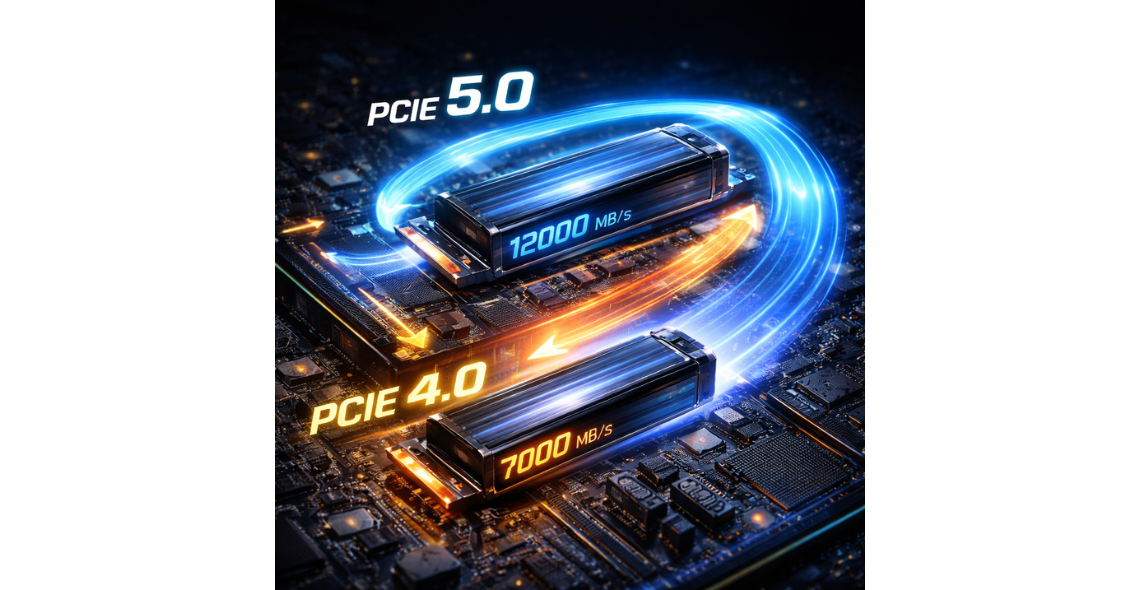
As enterprise infrastructure evolves, organisations are increasingly evaluating the transition from PCIe 4.0 NVMe storage to the latest PCIe 5.0 SSD technology. With modern workloads such as artificial intelligence, real-time analytics and large-scale virtualisation placing greater demands on storage systems, upgrading to the latest generation of enterprise SSDs can deliver significant performance improvements.
However, many IT teams are still asking a key question: Is upgrading from PCIe 4.0 to PCIe 5.0 SSDs worth the investment?
In this guide, we compare PCIe 5.0 vs PCIe 4.0 enterprise SSDs, exploring the key differences in performance, infrastructure requirements and long-term value for modern data centres.
What Is PCIe and Why It Matters for SSD Performance
PCIe (Peripheral Component Interconnect Express) is the interface used by modern NVMe SSDs to communicate with the CPU and system memory. Each new PCIe generation doubles the available bandwidth, enabling faster data transfer between storage devices and the rest of the system.
For enterprise environments running data-intensive workloads, PCIe bandwidth can significantly impact:
Application performance
Database response times
Virtual machine density
AI and analytics processing speeds
PCIe 4.0 SSD Performance
PCIe 4.0 has been the standard for enterprise NVMe storage for several years and continues to power many modern data centres.
Typical PCIe 4.0 SSD capabilities include:
Up to 7GB/s sequential read speeds
High IOPS performance for transactional workloads
Excellent reliability for enterprise storage arrays
PCIe 4.0 drives remain widely deployed in:
Virtualisation clusters
Enterprise database environments
High-performance storage arrays
For organisations operating stable infrastructure with predictable workloads, PCIe 4.0 continues to deliver excellent performance and reliability.
PCIe 5.0 SSD Performance
PCIe 5.0 represents the next generation of enterprise storage connectivity, doubling the available bandwidth of PCIe 4.0.
PCIe 5.0 SSDs can deliver:
Up to 14GB/s sequential read speeds
Higher IOPS performance
Reduced latency under heavy workloads
Improved throughput for data-intensive applications
This makes PCIe 5.0 particularly beneficial for environments running:
Artificial intelligence workloads
Real-time analytics platforms
High-frequency databases
Hyperscale cloud infrastructure
Modern enterprise drives such as the Memblaze PBlaze7 7940 Series PCIe 5.0 SSDs are designed to take full advantage of this increased bandwidth while maintaining enterprise-grade reliability and endurance.
Memblaze PCIe 5.0 SSDs in the UK
As organisations begin adopting PCIe 5.0 infrastructure, enterprise SSD solutions such as the Memblaze PBlaze7 7940 Series are becoming increasingly popular in data centre environments.
Origin Storage is the official UK distributor for Memblaze enterprise SSDs, providing access to the latest high-performance NVMe storage solutions for enterprise, cloud and hyperscale deployments.
Through Origin Storage, organisations can deploy Memblaze PCIe 5.0 SSDs across multiple form factors and capacities, including:
E1.S high-density SSDs
E3.S scalable enterprise drives
U.2 enterprise NVMe SSDs
You can explore the available enterprise drives in the Origin Storage solid state drive catalogue.
Infrastructure Requirements for PCIe 5.0
While PCIe 5.0 SSDs offer significant performance advantages, they require compatible hardware.
Key infrastructure requirements include:
PCIe 5.0 capable CPUs
PCIe 5.0 server motherboards
Updated firmware and NVMe controller support
Adequate cooling and airflow
Many new enterprise servers released in the past two years already support PCIe 5.0, making upgrades increasingly accessible.
PCIe 4.0 vs PCIe 5.0: Quick Comparison
When Should You Upgrade to PCIe 5.0 SSDs?
Upgrading to PCIe 5.0 storage is particularly beneficial for organisations running high-performance data centre workloads.
Consider upgrading if your environment includes:
AI or machine learning infrastructure
Real-time analytics platforms
High-transaction databases
High-performance computing clusters
For these environments, the performance gains from PCIe 5.0 can deliver significant improvements in application responsiveness and processing speed.
When PCIe 4.0 May Still Be Enough
Despite the benefits of PCIe 5.0, PCIe 4.0 remains suitable for many enterprise workloads.
PCIe 4.0 SSDs may still be appropriate if:
Your infrastructure does not yet support PCIe 5.0
Workloads are not bandwidth intensive
You are prioritising cost efficiency
Many organisations adopt a hybrid approach, deploying PCIe 5.0 storage in performance-critical tiers while maintaining PCIe 4.0 for general workloads.
Future-Proofing Enterprise Storage
As server platforms continue to evolve, PCIe 5.0 is rapidly becoming the new standard for enterprise storage performance.
Solutions such as the Memblaze PBlaze7 7940 Series, distributed in the UK by Origin Storage, are designed to support modern enterprise workloads with high-capacity NVMe storage and next-generation PCIe performance.
Organisations planning long-term infrastructure strategies should consider PCIe 5.0 as part of their roadmap to ensure storage systems remain scalable, efficient and capable of supporting future workloads.
To explore available enterprise NVMe solutions, visit the Origin Storage SSD product range.


Comments
There are currently no comments, be the first to comment.